Central Archive Entities The Pale Below
Case File · VB-NY-041
The Pale Below
Unresolved Subterranean Predator Threat · Severe
Archive Record
01Overview
The Pale Below are thin, humanoid predators found in abandoned or inaccessible spaces beneath large cities.
The name does not refer to a confirmed species, lineage, or single population. It is an operational designation applied to creatures sharing the same physical appearance, movement patterns, and unusual response to sound.
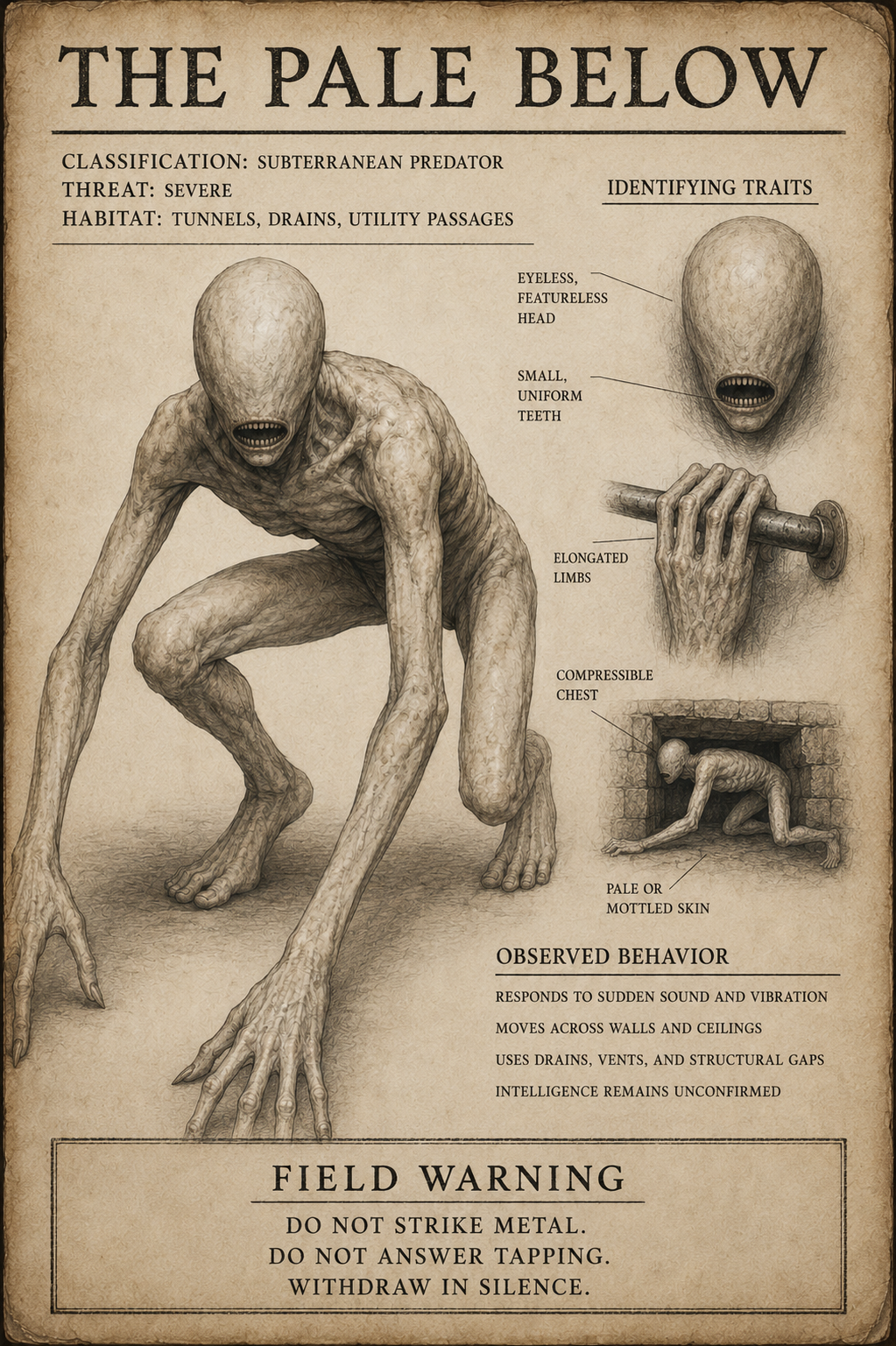
Their bodies are pale or mottled gray. Their heads possess no visible eyes. Most reported specimens have smooth faces broken only by a dark mouth containing numerous small teeth.
They move through tunnels, drains, ventilation systems, cable passages, and structural gaps that appear too narrow to admit their bodies. Witnesses describe their joints folding beyond ordinary limits and their rib cages compressing as they pass through confined openings.
They are almost entirely silent.
This silence is not evidence of caution alone. Their bodies produce little noise even when moving rapidly across metal, masonry, or loose debris. The only consistently reported bodily sound is a series of soft clicks associated with the compression or repositioning of the shoulders, chest, and limbs.
The Pale Below appear strongly attracted to sudden noise and vibration. Hammer blows, dropped tools, gunfire, railway movement, alarms, and impacts against iron have all preceded attacks.
No specimen has been recovered intact.
No confirmed origin has been established.
The Vigil does not know whether the creatures are animals, altered human beings, or something that merely resembles the human form.
02Origin of the Name
The designation first appeared in a handwritten margin within a New York watchhouse record:
We heard them moving under the men, though nothing could be seen. When the lamp found one, it was pale. When the lamp moved, there were more. Pale above us. Pale below.
The original account did not survive in full. The page had been removed from a larger report, and no date appeared on the surviving portion.
The phrase entered local use as the pale below.
Later record keepers mistakenly shortened the name to the Pale, suggesting a more definite classification than the evidence supports. Both forms remain in use.
The Vigil retains the older designation because it describes the condition in which the creatures are encountered without pretending to explain what they are.
03Physical Description
Descriptions are unusually consistent despite the poor conditions under which sightings occur.
Adult specimens appear approximately human in height when extended. This estimate remains uncertain because the creatures rarely stand upright. They crawl, hang, fold, or press themselves against surrounding structures.
Observed traits include:
- Pale white, gray, or lightly mottled skin
- Severe thinness, with ribs and joints visibly pronounced
- Long arms and legs
- Narrow torsos capable of substantial compression
- Smooth heads without visible eyes
- No clearly defined external ears
- Little or no visible nose structure
- A circular or oval mouth
- Numerous small teeth of similar size
- Long fingers capable of gripping brick, tile, pipe, cable, and rail
- Little apparent body hair
- No visible clothing, tools, or manufactured objects
Witnesses sometimes report a dark line across the ribs or abdomen. Whether this is pigmentation, scarring, an anatomical opening, or a shadow created by the structure of the chest is unknown.
Reports differ regarding sex characteristics. Most witnesses recall none. No juvenile specimen has been reliably identified.
The lack of visible eyes has led to the common assumption that the Pale Below are blind. This has not been proven.
Personnel are instructed not to mistake the absence of eyes for an inability to perceive position, movement, heat, light, or proximity.
04Movement
The movement of the Pale Below is the most reliable means of distinguishing them from injured people, escaped animals, or ordinary trespassers.
They can crawl on floors, cling to walls, and travel along ceilings. They frequently position their bodies against pipes, beams, or columns, using the architecture to break up their outline.
Their limbs remain recognizably human in basic structure, but the range of motion is not human.
A specimen may rotate a shoulder farther than the joint should allow, draw its arms tightly against its ribs, or flatten its torso enough to enter a drainage opening. Witnesses have described them folding around columns, withdrawing into cable recesses, and passing beneath maintenance doors without raising them.
These actions may be accompanied by soft internal clicks.
The sound has been compared to:
- Wet knuckles being cracked
- Wooden beads pressed together
- Teeth clicking beneath a closed mouth
- Small stones shifting under water
They can remain motionless for extended periods. During such periods, they are often mistaken for mineral deposits, bundled insulation, discarded cloth, or pale staining on concrete.
When they attack, the transition from stillness to movement is immediate.
Their speed is difficult to measure in confined spaces. Witnesses consistently describe it as faster than expected, particularly when the creature is moving through ducts, between columns, or beneath stationary railcars.
05Response to Sound
Sudden sound is the only confirmed attractant.
Not every noise produces the same response. Continuous mechanical noise may be tolerated or approached gradually. A sharp change in the environment produces a much faster reaction.
Known triggers include:
- Metal striking rail
- Dropped tools
- Gunshots
- Emergency alarms
- Shouted voices
- Breaking glass
- Slamming doors
- Hammering
- Sudden machinery activation
- Structural collapse
- Train vibration
- Repeated tapping transmitted through iron or steel
The creatures appear able to follow vibration through connected structures.
A strike against a rail may attract specimens far beyond the visible tunnel. The response can travel through track, pipe, grating, conduit, and structural supports.
This has led to several fatal misunderstandings.
Trapped workers have struck pipes or rails in an attempt to summon rescuers. Search teams have answered. In some incidents, tapping then approached both groups from more than one direction.
Personnel must never assume that a repeated pattern is human merely because it resembles a deliberate signal.
The Pale Below may produce tapping themselves.
Whether this is intentional communication, mimicry, incidental contact, or a hunting response remains unresolved.
06Sensory Capacity
The Pale Below orient their heads toward sound even though no external ears are visible.
They may detect vibration through their hands, feet, skin, teeth, or skeletal structure. Specimens have been observed placing one hand against a rail or pipe immediately before changing direction.
This behavior has encouraged the theory that they sense movement through buried metal.
The theory remains unproven.
They may also detect air movement. Several witnesses reported that a creature turned toward them after they breathed, shifted clothing, or opened a door without making any obvious sound.
Light sensitivity is uncertain.
Some specimens have withdrawn when exposed to powerful work lamps. Others have crossed directly through flashlight beams without hesitation. The difference may reflect brightness, heat, surprise, or simple individual behavior.
Darkness should not be considered protection.
Light should not be considered protection.
07Hunting Behavior
The Pale Below do not consistently charge the first sound they detect.
They may approach slowly, circle through adjoining passages, or remain above and behind a group until another noise occurs.
This behavior creates the appearance of planning.
The Vigil has not determined whether it represents intelligence or an effective predatory instinct.
Confirmed attack patterns include:
- Waiting beneath railcars or raised platforms
- Clinging above doorways
- Following from inside parallel service passages
- Entering rooms through vents or drainage openings
- Separating individuals by responding from multiple directions
- Remaining motionless while a light passes over them
- Approaching after a group stops moving
- Striking when machinery conceals the sound of their movement
The creatures appear to hunt collectively, but the extent of coordination is impossible to judge.
Multiple specimens may converge on the same sound because they share the same sensory response. This does not necessarily mean they communicate or cooperate.
They have never been observed carrying food, constructing shelter, caring for injured members, or defending territory in a manner the Vigil can confirm.
They have, however, been found gathered in large numbers beneath inactive machinery, particularly railcars, pumps, and ventilation equipment.
Whether these locations are nests, resting sites, feeding grounds, or simply acoustically favorable spaces is unknown.
08Vocalization
No verified witness has heard a Pale Below speak.
They do not scream during attacks.
They do not growl, hiss, or produce the breath sounds expected from an animal of comparable size.
The mouth may open without producing audible sound.
A few survivors reported feeling pressure in the ears when a creature opened its mouth nearby. Instruments were not present during these incidents, and physical injury may have contributed to the sensation.
Tapping remains their only suspected form of communication.
The patterns vary.
Some are irregular. Others repeat in groups of two or three. A few have closely imitated knocks produced by trapped workers.
No pattern has been translated.
No response experiment is authorized.
09Habitat
The Pale Below favor enclosed spaces beneath active human settlements.
Confirmed environments share several characteristics:
- Limited natural light
- Interconnected tunnels
- Persistent moisture
- Extensive iron or steel infrastructure
- Areas abandoned but not entirely isolated from active systems
- Machinery producing regular vibration
- Multiple narrow passages inaccessible to an adult human
They have not been reliably observed in open caves far from developed areas.
This does not mean they require cities.
It may mean only that cities create the conditions in which people encounter them.
Natural cavities often exist beneath or beside the artificial spaces they occupy. Several tunnel systems associated with sightings opened into older rock fissures, buried waterways, or caverns not shown on municipal plans.
It remains unclear whether the creatures entered the built environment from these natural spaces or whether the construction merely exposed populations already present.
10Distribution
The largest confirmed concentration exists beneath New York City.
The number of specimens is unknown.
Early estimates assumed a small population confined to a forgotten transit alignment. Later vibration events produced answering taps beneath several active lines, drainage corridors, and adjoining streets.
These responses occurred too far apart to have come from a single group.
Current estimates are not included in the standing file. The available evidence does not support a reliable count.
Similar reports have been collected from underground works in other cities. Most remain unconfirmed. Pale figures, tapping rails, disappearing workers, and unexplained movement in sealed tunnels occur frequently in urban folklore.
The Vigil does not classify every such report as evidence of the Pale Below.
At present, the New York population is the only one considered confirmed.
11Historical Record
The age of the population cannot be established.
Records of missing tunnel workers predate the oldest confirmed sighting, but underground construction has always been dangerous. Collapse, gas, flooding, machinery, and poor record keeping account for many disappearances.
The Vigil has found no credible ancient account that can be conclusively connected to the creatures.
This absence is significant only in a limited sense.
The Pale Below inhabit places rarely entered, poorly mapped, and frequently sealed after accidents. Their behavior also leaves little evidence aboveground. A body removed into a drain or construction void may never be recovered.
Scattered accounts from the nineteenth and early twentieth centuries describe:
- White hands withdrawing between tunnel supports
- Work bells followed by disappearances
- Knocking beneath rail lines after crews had left
- Men pulled upward into ventilation works
- Tools found beside empty boots
- Workers refusing to strike metal belowground
- Unexplained silence in otherwise active construction headings
Most were recorded as accidents, desertions, labor disputes, or superstition.
No single account proves the creatures were present.
Together, they establish a pattern the Vigil cannot dismiss.
12Feeding
The Pale Below attack human beings.
What they consume remains uncertain.
Bodies recovered after suspected encounters show extensive tearing, crushing, and removal of soft tissue. These injuries are consistent with feeding but do not prove it.
Some victims disappear completely.
Others are abandoned after severe injury.
No remains have been found inside a confirmed resting site in quantities sufficient to support the assumption that the creatures feed exclusively on humans.
No waste material, regurgitated matter, stored food, or recognizable digestive remains have been conclusively attributed to them.
Their mouths and teeth suggest feeding.
Their long periods of inactivity suggest they may survive for extended periods without it.
Both observations remain incomplete.
13Resistance and Injury
The Pale Below can be injured.
Whether they can be killed has not been confirmed.
Blunt force, cutting tools, electrical discharge, gunfire, fire, and crushing machinery have all been used during encounters. Several specimens appeared wounded. Pale or gray fluid has been reported, though none was collected under controlled conditions.
Injured creatures have withdrawn into spaces too narrow for pursuit.
In one incident, a specimen fell into moving machinery and did not emerge. Tapping resumed elsewhere in the structure minutes later. Investigators could not determine whether the same creature survived or another had responded.
Gunfire is strongly discouraged.
Within tunnels, a firearm creates several dangers:
- The report attracts additional specimens
- Ricochet risk is severe
- Muzzle flash damages night vision
- The shooter may not have a clear understanding of what lies beyond the target
- A wounded creature may retreat while others approach
A weapon capable of harming one Pale may summon many more.
14Signs of Presence
The following signs warrant immediate withdrawal:
- Repeated tapping from disconnected sections of rail
- Pale fingers visible inside drains or ventilation openings
- Tools or debris moved without accompanying footsteps
- Soft clicking within walls
- Sudden silence among rats or insects
- Movement beneath stationary railcars
- Smooth pale shapes flattened against ceilings
- Unexplained pressure in the ears
- Answering impacts after a loud sound
- Multiple responses approaching from different directions
None of these signs should be investigated alone.
Personnel must not place hands inside openings, even when the space appears too narrow to contain a body.
15Field Protocol
When entering a suspected habitat
- Remove or secure all loose metal equipment.
- Wrap tools to prevent accidental impact.
- Disable audible alarms where safely possible.
- Use light signals rather than spoken communication.
- Maintain physical contact with the nearest team member when visibility is limited.
- Do not step directly on exposed rail.
- Do not test suspected tapping.
- Do not separate to investigate movement.
- Mark the route without hammering, drilling, or attaching metal markers.
- Identify exits before proceeding beyond the first confirmed sign.
If a Pale is observed
- Stop moving.
- Do not shout.
- Do not fire unless immediate physical contact is unavoidable.
- Allow continuous background machinery to conceal slow withdrawal.
- Avoid touching rails, pipes, gratings, or conduit.
- Withdraw toward the nearest known exit.
- Do not attempt recovery of abandoned equipment.
- Do not pursue a retreating specimen.
If one member of the team is taken into an opening too small for immediate entry, the rest of the team must not follow.
This instruction has been added repeatedly to the file.
It remains the instruction most often ignored.
16Containment
No confirmed population has been contained.
Sealing individual passages may redirect movement into adjoining infrastructure. Concrete barriers, welded doors, and collapsed shafts have all failed to provide reliable long-term isolation.
The creatures exploit drainage gaps, ventilation systems, utility chases, and natural fractures around constructed barriers.
Containment efforts also risk trapping workers or investigators inside the affected area.
For these reasons, local sealing should be considered route denial, not containment.
The Vigil does not currently possess a reliable method for removing the Pale Below from a tunnel system.
17Intelligence
The question of intelligence remains open.
Evidence supporting intelligence includes:
- Apparent use of ambush positions
- Waiting until a group is divided
- Repeated tapping resembling human signals
- Movement through parallel routes
- Avoidance of direct light in some encounters
- Attacks timed with machinery or passing trains
Evidence against drawing this conclusion includes:
- Strong instinctive attraction to sudden sound
- Repeated exposure to obvious hazards
- Lack of tools or constructed objects
- No verified language
- No confirmed social behavior
- No evidence of long-term planning
Personnel must behave as though the Pale Below are capable of learning.
The archive must not state that they are.
18Unresolved Questions
The following questions remain unanswered:
- Are all observed specimens members of the same species?
- Are they born in their current form?
- Do they reproduce?
- Do they require food?
- Can they perceive light?
- Are they blind?
- Do they communicate through vibration?
- Are tapping patterns deliberate?
- Why do they gather beneath railcars and machinery?
- Did urban construction attract them or expose them?
- How far do their tunnel networks extend?
- Are similar creatures present beneath other cities?
- Can they survive aboveground?
- Has a specimen ever left the subterranean environment voluntarily?
- Do they avoid active passenger areas, or have they entered them without being recognized?
- How many exist beneath New York?
The Vigil has no definite answer to any of these questions.
Claims to the contrary should be treated as speculation.
19Final Assessment
The Pale Below are dangerous because the environment favors them.
Underground, every human advantage becomes uncertain. Light reaches only a short distance. Maps omit older passages. Radios fail. Water conceals movement. Steel carries sound beyond sight.
The creatures require no proven intelligence to exploit these conditions.
They need only wait.
Investigators should not assume that an abandoned tunnel is empty because no movement is visible. They should not assume that a sealed passage is secure because no person can enter it. They should not assume that tapping is a request for rescue.
The most serious mistake is to believe that a sighting represents a lone specimen.
Where one is seen, others may already be positioned beyond the light.
If iron answers from beneath the city, do not answer it.