Central Archive Entities Werewolves
Werewolves
Archive Classification Human Changed
A werewolf is a human being altered by lycanthropy. It is not an animal capable of assuming human shape, an undead creature, or a separate species concealed among humanity. The afflicted remain biologically human until transformation begins.
The distinction matters. A werewolf has a family, a history, and a human life. It can grow old, become ill, and die from ordinary causes. Lycanthropy does not grant immortality. It does not halt aging, preserve youth, or protect the afflicted from disease.
It does, however, place another nature within the human body, one that cannot be permanently subdued.
There are only two known physical states: human and transformed. Accounts describing werewolves becoming ordinary wolves are folklore, mistaken observation, or deliberate invention.
The First Pack
The oldest account accepted by the Archive places the beginning of lycanthropy on Mount Lykaion in Arcadia, sometime around 1100 BCE.
The surviving account is incomplete. It describes nine people who willingly took part in a rite intended to draw the strength, endurance, and ferocity of the wolf into the human body. Whether they were warriors, guardians, religious devotees, or desperate members of a threatened settlement remains uncertain. Later copies disagree on nearly every detail except their number and the location of the rite.
Something answered them.
One of the nine changed before the others. The oldest fragment calls this figure only the First Wolf. The remaining participants transformed soon afterward, becoming what later records named the First Pack.
The ritual succeeded, but not in the manner its participants intended. The strength they sought could not be summoned and dismissed at will. It became part of them. The change returned with the moon, passed into their descendants, and eventually spread through violence.
The Greek story of Lycaon, the king transformed into a wolf as punishment for serving human flesh to Zeus, is believed to be a corrupted memory of these events. The myth preserved the mountain, the transformation, and the association with forbidden rites, but replaced the First Pack with a single impious king.
No complete account of the original rite survives. The Vigil has never attempted to reconstruct it.
Lycanthropy
Lycanthropy is a permanent alteration of the human body. Whether it should be understood as a disease, curse, inherited condition, or something for which no satisfactory term yet exists remains disputed within the Archive.
It enters a human life in one of two ways.
Inheritance
Some werewolves are born with lycanthropy. The condition may pass from parent to child, although inheritance is inconsistent. A werewolf may have several unaffected children, while the condition may appear in a later generation after remaining dormant within a family.
There are no pure bloodlines, ancient werewolf houses, or reliable dynasties. Such claims usually originate with families attempting to turn an affliction into a source of status. Lycanthropy does not respect genealogy neatly enough to support them.
A child carrying the condition may appear entirely ordinary for years. The first transformation most commonly occurs during adolescence, though earlier and later cases are documented. Illness, injury, terror, or severe emotional distress may cause the condition to manifest before the first compulsory lunar transformation.
Transmission
Lycanthropy may also be transmitted through the bite of a fully transformed werewolf.
Transmission is uncommon and unpredictable. Many victims die from their injuries. Others survive without developing the condition. No test can determine immediately whether transmission has occurred.
A bite delivered while the werewolf is in human form carries no known risk beyond that of an ordinary human bite.
All survivors of an attack must be observed through at least one complete lunar cycle. A single uneventful full moon does not always provide certainty. Delayed manifestations have occurred, particularly when the victim was heavily sedated, gravely ill, or unconscious during the expected transformation.
Transformation
The full moon compels transformation.
Moonlight itself is unnecessary. Underground chambers, sealed rooms, cloud cover, blindness, and physical isolation offer no protection. The change is tied to the lunar cycle rather than direct exposure to the moon.
Outside the full moon, transformation may be triggered by extreme stress. Common causes include injury, panic, rage, hunger, physical threat, and the instinct to protect another person. Some werewolves transform only during the full moon. Others become increasingly unstable as the moon approaches, with involuntary changes occurring several nights before or after it.
No transformation is painless.
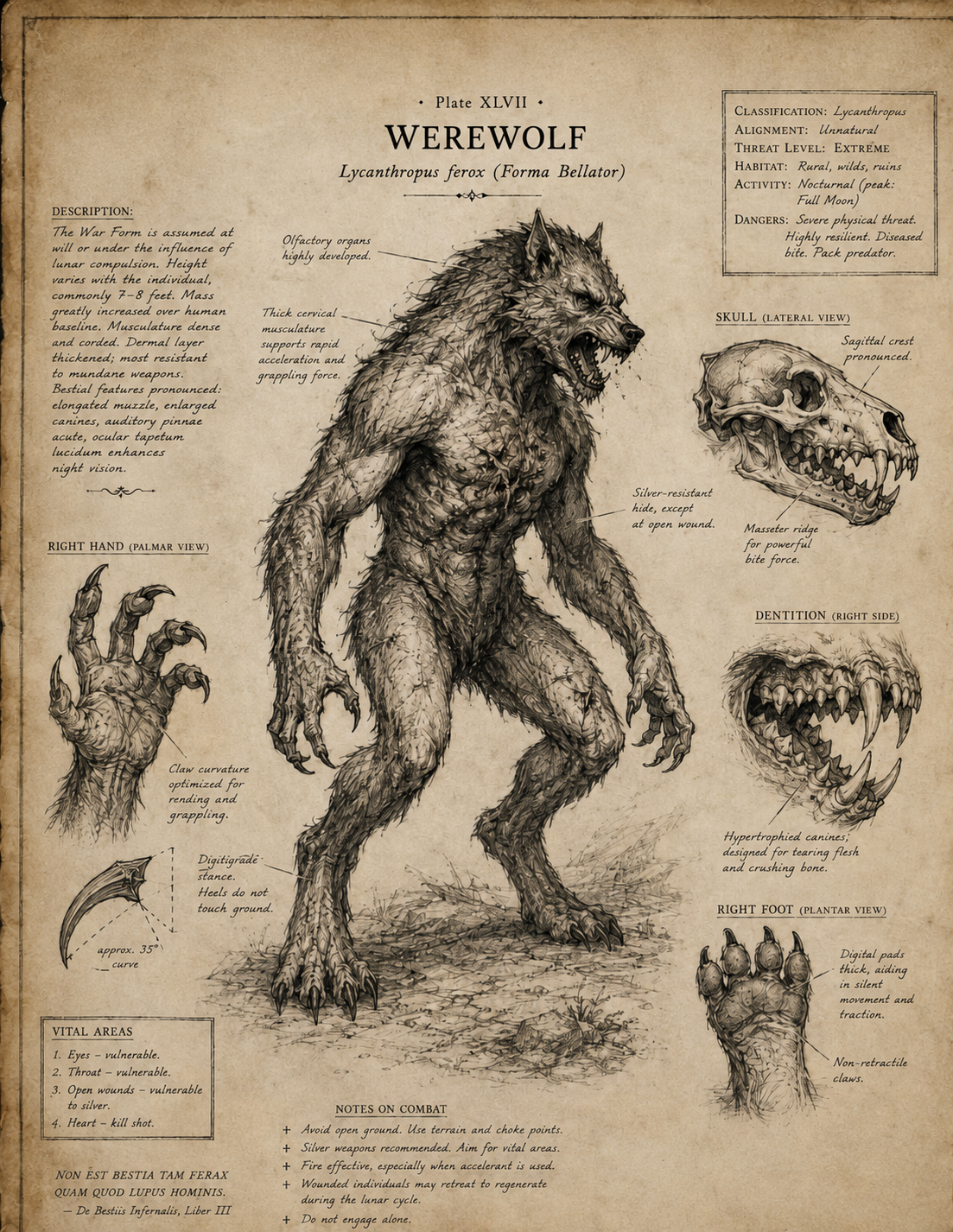
The human skeleton breaks and reforms. The spine lengthens, the chest expands, and the skull pushes forward into a heavy muzzle. Teeth are displaced by larger replacements. The hands broaden into clawed extremities while retaining enough structure to grasp, climb, and tear. The legs become heavily muscled and jointed for sudden acceleration, but the creature remains bipedal.
The final appearance is neither human nor wolf. It is a towering, predatory union of both, usually covered in coarse hair and standing considerably taller than the person's human body. Individual differences remain visible. Hair color, body mass, old injuries, missing limbs, and certain facial characteristics may carry into the transformed state.
The process reverses when the transformation ends, leaving severe exhaustion, dehydration, muscular damage, and intense hunger.
The Mind Within the Beast
Transformation does not affect every werewolf in the same way.
Some retain fragments of their human awareness. They may recognize familiar people, understand speech, avoid particular locations, or resist attacking someone emotionally important to them. A very small number retain enough intelligence to make deliberate choices.
Others remember nothing.
These cases are known among hunters as Blackouts. The afflicted awaken after transformation with no memory of what occurred. They may find themselves miles from home, naked, injured, or surrounded by evidence of violence they cannot explain.
Memory should not be mistaken for control. A werewolf may remember everything and still have been unable to resist its instincts. Another may remember nothing yet have avoided harming anyone.
The transformed mind is dominated by hunger, fear, aggression, territory, and recognition. Human loyalties may remain, but they are filtered through an animalistic nature that reacts before it reasons. Even experienced werewolves can become unpredictable when wounded, cornered, or exposed to unfamiliar scents.
No werewolf should ever be considered completely controlled.
Packs
Werewolves sometimes gather in packs, but these groups are not formal clans or hereditary societies.
Most packs begin for practical reasons. Experienced werewolves help newly changed individuals survive their first transformations. Members isolate themselves together, watch over one another's families, conceal evidence, and prevent uncontrolled hunting. Some packs are little more than several afflicted people sharing a secure place during the full moon.
Others become territorial and violent.
Transformation intensifies instincts of dominance, protection, and possession. A location used repeatedly by a pack may become fiercely defended. Intruders can provoke an attack even when they present no deliberate threat. Conflicts between packs are usually disputes over territory, safety, food, or perceived encroachment rather than ancient feuds.
A pack may reduce the danger posed by its members, or magnify it. Its existence alone proves nothing.
Strays and Ferals
The terms Stray and Feral are field language, not biological classifications.
A Stray is a werewolf living without the support or restraint of others who understand the condition. Some choose isolation because they fear harming those close to them. Others have been driven from a pack or abandoned after their first transformation. Strays are often dangerous because they lack preparation, not because they are deliberately hostile.
A Feral is a werewolf whose predatory nature has overtaken nearly every remaining human restraint. Ferals hunt people knowingly, defend killing grounds, and may begin provoking transformation outside the full moon. Some remain outwardly human between changes and are capable of conversation, deception, and planning.
Feral behavior is not always permanent, but recovery becomes less likely with every deliberate kill. The Vigil has recorded cases in which human identity survived beneath years of violence. It has also lost hunters who mistook recognition for remorse.
Physical Capabilities
In transformed state, a werewolf possesses strength, speed, and endurance far beyond ordinary human limits. Exact ability varies according to the individual's health, age, and experience.
Common capabilities include:
- The strength to overturn vehicles, break wooden doors, and tear through light structural barriers
- Short bursts of speed sufficient to overtake a running human
- Acute hearing and scent recognition
- Exceptional night vision
- Rapid clotting and accelerated recovery from wounds
- Continued movement despite injuries that would incapacitate a human
- Powerful territorial and tracking instincts
Healing is an emergency survival response, not immortality. The body can close wounds and stabilize severe injuries, but doing so consumes enormous energy. A badly injured werewolf may survive the immediate wound only to collapse from exhaustion afterward.
Damage to the heart, brain, or upper spine remains fatal. Blood loss, suffocation, fire, crushing injury, and catastrophic bodily trauma can also kill them.
Wolfsbane
Wolfsbane is toxic to werewolves, though its effects are often exaggerated.
Exposure may weaken the transformed body, disrupt accelerated healing, and interfere with the ability to maintain transformation. Concentrated doses can cause paralysis, organ failure, or death. The plant is also poisonous to ordinary humans, making careless use dangerous to hunters, victims, and the afflicted alike.
Wolfsbane is not a cure. It cannot remove lycanthropy or prevent all future transformations.
Its potency varies according to preparation, freshness, dosage, and the individual werewolf. It should never be treated as a reliable substitute for distance and preparation.
Conduct Between Transformations
Most werewolves spend the greater part of their lives as ordinary human beings.
Some hold jobs, raise children, form relationships, and take extensive precautions to protect others. They may retreat to remote locations before the full moon, use reinforced rooms, ask trusted companions to restrain them, or sedate themselves heavily enough to reduce mobility.
These methods sometimes work.
None work forever.
Chains break. Sedatives lose effectiveness. Reinforced rooms deteriorate. A person who has controlled the condition for twenty years may fail on the twenty-first. Confidence is one of the most dangerous symptoms observed in long-term cases.
Others accept the transformed state and begin arranging opportunities to hunt. They choose isolated homes, take occupations that allow unexplained absences, or settle near wilderness where disappearances attract less attention. The most dangerous learn to use their human lives to conceal what they do during transformation.
The Vigil judges such individuals by their actions, not merely by their condition.
Folklore and Error
Werewolf folklore contains fragments of truth surrounded by centuries of fear, religious interpretation, and invention.
The condition is not caused by wearing a wolf skin, drinking from an animal's footprint, sleeping beneath the moon, or being born on a particular holy day. Removing the skin of a transformed werewolf does not reveal the human beneath. Calling the afflicted by name may attract recognition, but it does not force transformation to end.
Werewolves do not become natural wolves. Any account describing an ordinary wolf that later resumed human shape should be treated as a separate phenomenon, a mistaken identification, or an unreliable report.
Killing the werewolf who transmitted the condition does not cure the victim. Neither confession, exorcism, baptism, nor forgiveness has been shown to remove lycanthropy.
No cure verified by the Vigil has ever survived independent examination.
Vigil Position
A werewolf is dangerous. It is not automatically guilty.
The condition may be inherited by a child or inflicted upon a victim who had no knowledge of the supernatural. Many afflicted people spend their lives attempting to prevent harm. Others use lycanthropy as permission to indulge impulses they possessed long before their first transformation.
Hunters must distinguish between the unwilling, the careless, and the predatory.
When possible, the afflicted should be approached while human. Their preparations, history, and conduct during previous transformations should be examined. Evidence of feeding, concealed deaths, missing travelers, territorial markings, or repeated failures of containment must be taken seriously.
During transformation, distance is the first defense. Ordinary restraints should not be trusted. A cornered werewolf will attack, and a wounded one is often more dangerous than an uninjured one.
A hunter who sees only the beast may murder an innocent person.
A hunter who sees only the person may not survive the night.
The werewolf is neither the face seen by daylight nor the thing that rises beneath the moon. It is the burden of being both.
Recorded in the margins of the Thessalonica Field Copy, author unknown, late sixth century.