I.
I drove up the coast the morning before the storm, the radio cutting in and out as the road curved inland then back toward the water. The forecast had been on every station for three days: a nor’easter building offshore, expected to make landfall sometime after midnight. My mother had called twice to ask if I was coming. I told her yes both times, though I had not decided until I was already on the road.
The house looked smaller than I remembered. It always did. Thirty-some years of memory had a way of enlarging things that time then quietly reduced. The cedar shingles had gone gray and needed replacing on the south side. One of the shutters hung at a slight angle. My father’s truck sat in the gravel drive, salt-pitted along the wheel wells, and the sight of it made something small and tired settle in my chest.
My mother opened the door before I reached it.
“You made good time,” she said.
“Roads were clear.” I kissed her cheek. She smelled of coffee and the particular salt-damp smell that had lived in that house for as long as I could remember.
Inside, my father sat at the kitchen table with the newspaper open in front of him, though he was not reading it. He looked up when I came in.
“Storm’s going to be something,” he said.
“Sounds like it.”
He nodded and looked back down at the paper. We had talked like that for years. Not unkindly. Just with the careful economy of people who had learned to keep certain doors closed.
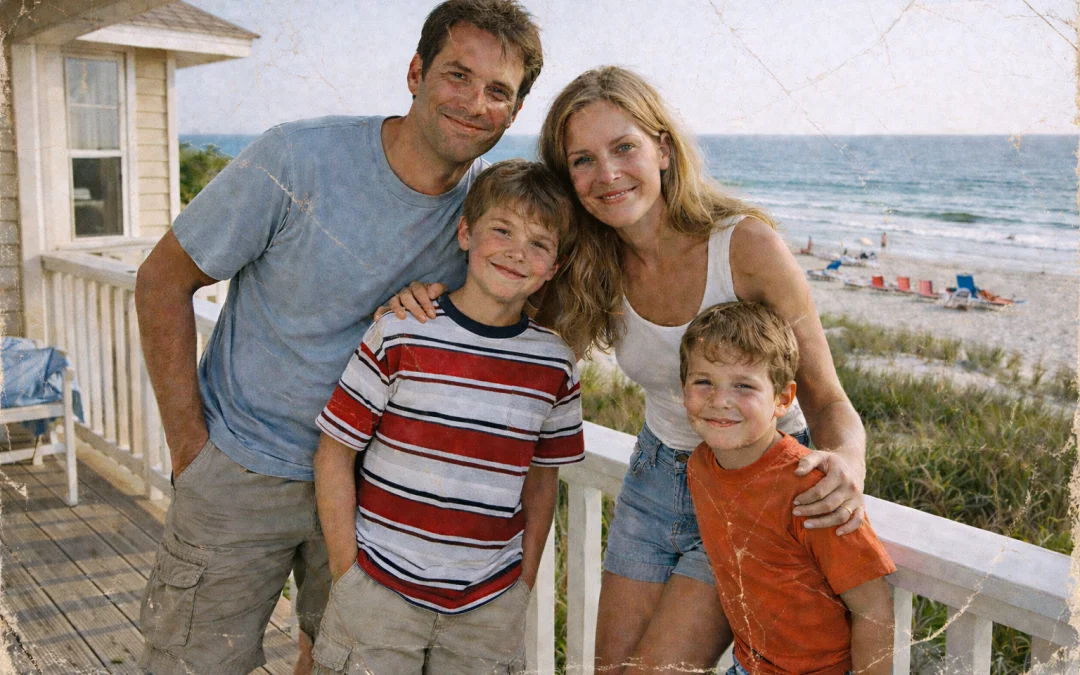
The house held photographs on nearly every wall. Most of them I could recite from memory. My mother at twenty, standing in front of the old Buick. My parents on their wedding day, the photo slightly overexposed so they looked half dissolved in light. And on the shelf above the fireplace, the one my eyes always found and then moved away from: the four of us on this very beach, the summer before everything changed. My parents younger than I was now. My brother grinning with a broken shell in his hand, his hair pushed sideways by the wind.
He would have been thirty-three this year.
I stood at the back window and watched the ocean. The water had gone that particular shade of green-gray it takes on before a storm, and the waves were coming in longer and flatter than usual, the way they do when something large is organizing itself offshore. The beach grass bent steadily in one direction. There was no rain yet but you could feel the pressure of it waiting.
That was when I noticed the footprints.
They ran along the wet sand below the tide line. Small. Barefoot. Coming up from the water’s edge and then turning toward the house before stopping. I pressed closer to the glass. The light was failing and the distance was enough that I could have been wrong. I told myself I was probably wrong.
I put on my coat anyway.
II.
The wind had real teeth in it by the time I stepped outside. I walked down through the beach grass, which pulled at my ankles, and crossed the dune to the harder sand below. The footprints were there. I crouched over them. They were the size of a child’s foot. Each one was filled partway with water from the last wave that had come through, blurring the edges.
I stood and looked down the beach. In both directions there was nothing. Just sand and the darkening sky and the white tops of the waves.
I was walking back toward the dune when the lightning came. A long, forking flash that lit the whole coastline in one sudden, bleached second. And in that second I saw him.
He was standing at the water’s edge about fifty yards down the beach. A boy. Small and still, facing the ocean, his back to me. His clothes were wet and dark, pressed against him by the wind. He was not moving.
I stood completely still until the darkness came back. Then I walked toward him.
He turned before I reached him, as if he had heard me, though the wind was loud. He looked at me the way you look at someone you know but have not seen in a long time. Searching and uncertain.
He had the same haircut. The same worn blue T-shirt, the one with the small tear near the collar, the one he had been wearing that last day. His feet were bare in the cold sand.
He was thirteen years old.
He was my brother Danny.
I could not speak. I am not sure I breathed.
“Hey,” he said. His voice was exactly as I had kept it in memory. Slightly hoarse. A little uncertain.
I said his name.
He looked at me with those same eyes, gray-green like the water, and then he looked past me at the house.
“I got pulled under,” he said. As if it had just happened. As if this were an explanation.
I nodded.
“I couldn’t get back up,” he said. “The current kept.” He stopped. He looked down at his feet in the sand. “Where were you?”
I had carried that question for twenty years without knowing it. I had it ready. I had practiced it in my sleep, worked it over in the dark quiet of countless rooms since. And standing there on the beach with the storm building offshore and my brother standing in front of me, thirteen years old and twenty years gone, I had nothing to say.
“I was on the beach,” I told him finally. “I was right there.”
He nodded slowly. He seemed to accept this, though I was not sure he fully understood it. He looked back at the house.
“Is Mom home?” he asked.
“Yeah,” I said. “She is.”
I took off my coat and put it around his shoulders and he let me, the way he used to when we were small. We walked up through the beach grass toward the house.
III.
My mother was at the kitchen sink when we came through the back door. She turned at the sound of us and her face went through several things very quickly. Disbelief first. Then something that was not quite recognition and not quite shock but some state in between. Her hand gripped the edge of the counter.
“Danny,” she said. Not a question. It was a word placed carefully in the air, like something fragile being set down.
He looked at her from under my coat, his wet hair flattened against his forehead.
“Hi, Mom.”
She crossed the kitchen and put both hands on his face. She held it there, studying him. Her eyes were very bright.
“You’re so cold,” she said.
“I’m okay.”
She pulled him against her and held on. I stood by the door and looked at my father, who had come to the kitchen doorway. He stood there with his hand on the doorframe. He was a man who had not cried in front of me in twenty years. I watched him look at his son. I watched his face do the thing that faces do when something impossible becomes undeniably present.
He cleared his throat.
“Hey, buddy,” he said. His voice came out rough and quiet.
Danny looked over at him. He smiled. The same crooked smile.
“Hey, Dad.”
My mother finally released him but kept one hand on his shoulder as she steered him to the kitchen table. She moved the way she had always moved around him: with a kind of automatic, gravitational attention. She found a towel. She brought him a glass of water. My father sat across from him and just looked at him the way you look at something you thought you would never see again.
Danny looked around the kitchen.
“The walls are different,” he said.
“We repainted,” my mother said. “A few years after.” She paused. “After.”
He took that in. He looked at the refrigerator. He looked at the window.
“There’s a different clock.”
“The old one stopped working,” my father said.
Danny nodded. He looked at me then, really looked at me, in a way he hadn’t done on the beach.
“You look different,” he said.
I was thirty-one years old. When Danny drowned I had been eleven. I tried to do the math from where he stood. Twenty years.
“Yeah,” I said. “I do.”
“You got big.”
“I did.”
He looked at each of our parents in turn. He was quiet for a moment.
“You all look older,” he said. He said it without any cruelty. It was simply an observation, the way children observe things. Directly and without armor.
None of us answered.
IV.
It was my father who finally tried to explain.
He sat across from Danny at the kitchen table with his big hands wrapped around a coffee mug he wasn’t drinking from, and he spoke slowly and carefully. He said that time had passed. A lot of time. He said that things had changed while Danny had been gone.
Danny listened. He was a patient listener. He always had been.
“How much time?” he asked.
“Twenty years,” my father said.
Danny went still. He looked at the table. He looked at his own hands, which were pale and very clean.
“Twenty years,” he repeated.
“Yes.”
He sat with that for a while. Outside the wind picked up and the windows shuddered in their frames. The storm was closer.
“So I’m thirty-three?” he said.
“You would be,” my father said.
Something passed across Danny’s face that I could not quite name. Not grief. Something more like the beginning of a very long thought.
“But I’m not,” he said.
“No.”
My mother had been standing at the counter with her arms crossed tightly over her chest. She had not been able to sit.
“Are you hungry?” she asked. “I can make something.”
“I’m okay.” Danny looked up at her and then back at our father. “What happened? I mean, everything. What happened to everyone?”
My father looked at me. I sat down at the table.
I told him as much as I could make make sense of. I told him about high school, which I had gone through without him beside me. About the way our parents had eventually stopped coming to the beach house every summer, then started coming again a few years ago because our mother said she needed to stop being afraid of the place. I told him about my apartment in the city, about the job I had that I didn’t love but was good at, about the way ordinary life had continued to build itself around the shape of his absence the way a tree grows around an old wound.
He asked simple questions. What kind of car did I drive. Did we still have the dog. He didn’t remember that we’d had to put the dog down the winter after he drowned.
“Oh,” he said quietly. “I liked that dog.”
“We all did.”
He looked at the shelf above the fireplace, at the photograph of the four of us.
“I remember that day,” he said.
“So do I.”
He was quiet again. Then:
“Why are you all so sad?”
It came out simply, with the particular directness of someone who had not yet learned to talk around things. My mother made a small sound and turned toward the window. My father looked down at his hands.
“Because we missed you,” I said. “We’ve been missing you for a long time.”
He looked at me carefully.
“I didn’t know it was so long,” he said.
“I know.”
“It didn’t feel like anything,” he said. “It was just.” He stopped. He shook his head. “I don’t know how to say it.”
“You don’t have to.”
He picked up the broken piece of shell that was sitting on the table. I didn’t know where it had come from. He turned it over in his fingers, looking at it, and set it down.
V.
The storm arrived around ten o’clock. Rain came first, then wind that made the whole house sound different. My father lit the fireplace. The lights flickered once but held.
It is strange, the things the night became.
My father found Danny’s old fishing rod in the closet off the mudroom, still in its case. He brought it out and sat on the couch with Danny and showed him again how to tie the basic knots. Danny’s fingers were slow with it at first. Then something came back to him and his hands remembered what to do. My father watched his son’s hands and did not speak.
My mother sat in the chair by the fire with Danny leaning against her shoulder. She brushed the sand from his hair the way she used to before bed, slowly and without hurry. The wind battered the windows. Neither of them seemed to notice.
I sat across from them and tried not to stare and stared anyway.
At some point Danny asked to play cards. We played three rounds of the game we had always played in that house. He won the second round, the same way he always used to win, by keeping his face perfectly still and giving nothing away. My father laughed when Danny laid his hand down. An actual laugh, genuine and surprised, the first I had heard from him in I couldn’t say how long.
“You still have that face,” my father said.
“What face?”
“That face where you know something and you’re not telling.”
Danny smiled. He set the cards down and picked up the shell again. He turned it over once and set it on the windowsill.
We did not talk about the obvious thing. We all knew it was there. You could feel it the way you feel a room’s true temperature once you stop moving. But the night had a quality of fragile light about it and we were all, by some unspoken agreement, protecting it.
Around midnight Danny fell asleep on the couch. My parents and I sat in the kitchen and drank tea and did not say very much. The storm was loud and steady. My mother held her mug in both hands.
“His clothes,” she said quietly.
I nodded. His clothes had never dried.
She looked toward the living room where he was sleeping.
“I know,” she said. Meaning something else. Meaning she had known since the moment she saw him what this night was. “I think I knew from the beginning.”
My father got up and stood at the window. Outside there was nothing to see but the dark and the rain running down the glass.
“We should sleep,” he said. “Whatever happens, we should sleep.”
VI.
I did not sleep. I sat in the chair by the window and watched the storm move through and tried to hold the night still. It would not hold.
I kept thinking about the day he drowned. The way the morning had been ordinary in the way that final mornings always turn out to have been. We had eaten cereal at the kitchen table. My mother had told Danny to put on sunscreen and he had made a face. My father was reading something. The dog was asleep on the porch.
Then we were on the beach, which we had gone to every summer of my life, and the water was cold but we were in it anyway, the way you always ended up in the water no matter how cold it was, and Danny went out further than I did because he always did, and I was standing in the shallower part where the waves came up to my waist, and I saw the wave and then I didn’t see him.
I had gone under once myself, that same summer, and I knew how it felt. The world going sideways. The sand moving under your feet in a direction that didn’t make sense. The awful disorientation of suddenly not knowing which way was up. I had come back up. I had coughed and stood and the water had been only waist-deep.
He had not come back up.
The current there ran unpredictably close to shore. A man from down the beach found him. My parents were on the sand. I stood at the water’s edge for a long time, not fully understanding, the cold moving up my legs.
I had told the story to therapists, to friends, to the woman I was with for three years who finally said she felt like she was in a relationship with his absence more than with me. I had told it until it became a kind of worn object, smooth from handling. But there was a part of it I had never told anyone.
I had seen him go under.
I had been standing right there, and I had seen it, and for a moment, one single moment, I had not moved. Not out of fear. Not out of anything I could ever name. I had simply stood there, and by the time I moved he was already gone.
I had carried that moment for twenty years without putting it down.
Around four in the morning the storm began to ease. The rain went from a roar to a sound more like breathing. I could hear the ocean again, the real sound of it underneath everything else.
Danny was awake when I came back to the living room. He was sitting up on the couch, looking at the window. The shell was in his hand.
“It’s quieter,” he said.
He nodded. He looked at his feet, still bare, still pale.
“I have to go back,” he said. Not a question.
I sat down beside him.
“Yeah,” I said.
He turned the shell over in his hand a few more times.
“I don’t remember what it was like,” he said. “Before. Or after. It wasn’t like anything.”
“Okay.”
“Are you scared? Of it?”
I thought about that honestly.
“Some,” I said. “Not the way I used to be.”
He nodded as if this was a reasonable answer. He set the shell on the couch cushion between us.
“I’m sorry I scared you,” he said. “That day.”
I looked at him.
“I’m sorry I didn’t get to you faster,” I said.
He shook his head slowly, not dismissively but in the way you do when someone is apologizing for something that is already past changing.
“It’s okay,” he said. And it sounded true when he said it. Not generous. Just true.
I went and woke our parents.
VII.
We walked out together in the early gray of before-dawn. The storm had taken the night somewhere else and left the beach cleaner and colder. The sand was dark and smooth where the waves had run up and retreated. Somewhere offshore a foghorn moved through the mist at long intervals.
Danny walked between our parents. My mother held his hand. She had his fingers wrapped in both of hers and she was looking straight ahead the way you look when you are trying not to look at something.
He was carrying the broken shell.
The water was calmer than it had any right to be after a storm like that. Long low swells came in and dissolved on the sand without much fuss. The seagulls had come back and were working the waterline in their methodical way, and the sky out over the ocean was beginning to separate itself from the horizon in the thin early light.
We stopped at the tide line.
Danny turned to my father first. My father looked at him for a long moment. Then he pulled him in and held him the way you hold something you are about to let go of. Danny was small against him.
“You were a good fisherman,” my father said. His voice was steady. He was working to keep it that way.
“You were a good teacher,” Danny said.
My father stepped back. He put his hand on top of Danny’s head once, the old gesture, and then he put his hands in his pockets.
My mother knelt on the wet sand so she was at his level. She put her hands on his face again.
“I want you to know,” she started.
“I know,” Danny said.
“I want to say it.”
He let her.
She told him. She took her time. Some of it I could hear and some of it was swallowed by the wind. I was not meant to hear all of it. When she finished she kissed his forehead and stood up. She did not let herself look away from him.
He turned to me.
Up close I could see that his eyes were the exact color of the water in this light. I had forgotten that. I had kept the memory so long that the details had softened.
“I missed you,” he said.
“I missed you more than I know how to say.”
He seemed to consider this.
“I know,” he said. He said it the way our mother had said it to him. Not dismissing the feeling but acknowledging it as something real that did not require a larger answer.
He held out the shell. The broken one. I took it.
He looked at the water. He looked back at me.
“It’ll be okay,” he said. “For you guys. I think.”
“Yeah?”
“Yeah.” He said it with a certainty that had no reasonable basis. The certainty of someone who is thirteen and has no particular reason to doubt that things work out. “You’ll be okay.”
He turned toward the water.
He walked slowly, without hurry, his feet leaving marks in the wet sand that the next small wave came in and smoothed over. He walked into the shallows. The mist was heavier out there, the kind that happens before full light when the air hasn’t decided yet what temperature it wants to be. He kept walking.
The mist folded around him.
He was gone.