
I.
The woman who came in on a Thursday in November did not look like someone who had missed three nights of sleep. She looked like someone who had missed years of it, her face drawn down around its bones the way the skin of a fruit draws down when the moisture inside has started to go. She was twenty-six, according to the intake form. Her name was Claire Ashworth. Under the line that asked her to describe her reason for visiting she had written, in very small handwriting, I am afraid to go back.
Dr. Elias Mercer read this in his office before calling her in, and he registered it the way he registered most things patients wrote in that particular space on the form: as a starting point rather than a conclusion. Patients who were afraid to go back somewhere were usually afraid to go back to a relationship, a job, a version of themselves they recognized before some catalyzing event. Fear of return was one of the more common presentations he saw. He had a framework for it, which was the product of twenty years of clinical practice and which he trusted.
He called her in.
She sat in the chair across from his desk and folded her hands in her lap with the deliberate care of a person keeping track of all their parts. Up close she was worse than the waiting room had suggested. Her eyes had the red rims and the particular flatness of the severely sleep-deprived, and they moved around the room in a way that was not quite restless and not quite fearful but occupied a space between the two that he did not have a ready clinical name for.
“Tell me what’s been happening,” he said.
She looked at him for a moment as if assessing whether he was likely to believe her. It was a look he had seen before in patients who had already told their story to someone else and been dismissed.
“I’ve been having a dream,” she said.
He nodded. He kept his face neutral. His face had been trained over two decades to remain neutral, and it was very good at it.
“Every night,” she said. “The same one.”
“Describe it for me.”
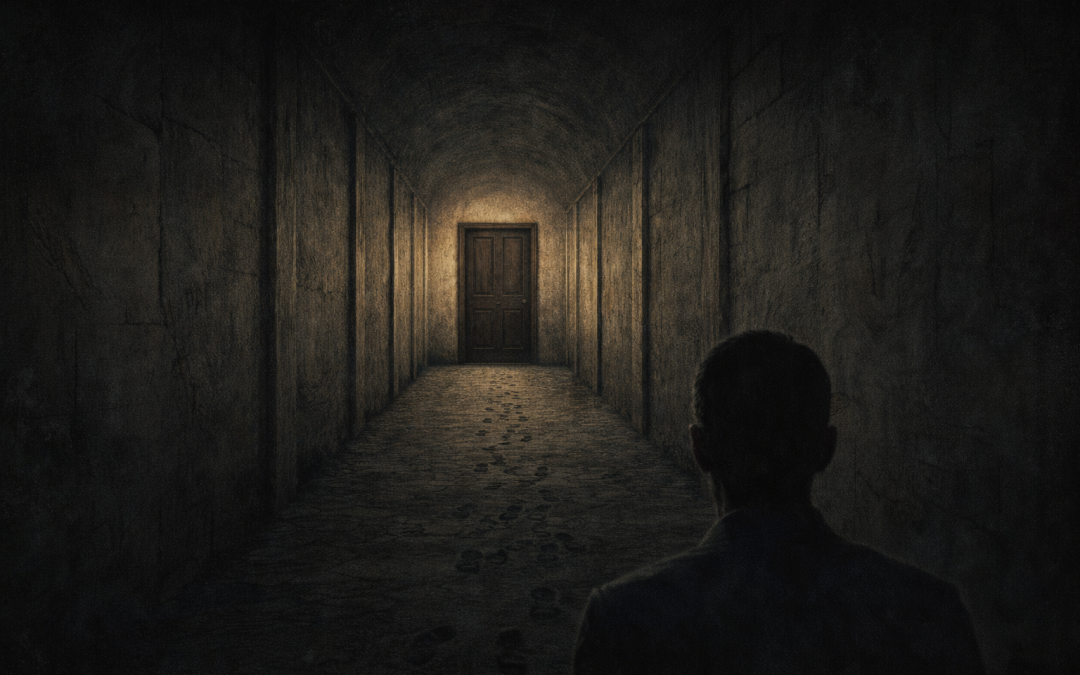
She looked at her hands. “A hallway,” she said. “Long. Bare walls, bare floor. The light just sort of exists, you can’t find where it’s coming from. It’s not bright, not dark. Just lit. And at the end of the hallway there’s a door.”
“What kind of door?”
She seemed to think about this. “Old. Wood. Not remarkable. Just a door.” She paused. “I start at one end of the hallway. Very far from the door. Far enough that I can barely see it. And then I wake up.”
“That’s the entire dream? You stand in the hallway?”
“The first night, yes. The second night I’m closer. Not by much. A few feet, maybe. But closer.” She lifted her eyes to him. “Each night I’m closer than the night before.”
Mercer made a note. Recurring spatial dream with incremental progression. The architecture of it was not unusual. Repeating dreams with a fixed destination, a goal object, were well documented in the literature. Anxiety expressions, typically. The brain rehearsing an approach to something it found threatening, a looping attempt to process an unresolved problem through the symbolic grammar of sleep. He had treated dozens of them.
“How long has this been happening?” he asked.
“Eleven nights.”
“And you’ve stopped sleeping because of it?”
“I’ve stopped sleeping,” she said, “because I don’t want to get any closer.” She said it simply, without drama, the way you state a practical decision you have already made and do not intend to revisit. “Each time I wake up I feel that I have actually traveled somewhere. Not that I dreamed traveling. That I went.” She looked at him with those flat, red-rimmed eyes. “Does that make sense to you?”
He kept his face where he had put it. “It’s a very common feature of vivid or recurring dreams,” he said. “The sense of physical presence. The brain processes the dream environment through the same regions that process waking spatial experience, so the feeling of having been somewhere is neurologically genuine, even when—”
“I know what you’re going to say,” she said quietly. “I’ve read about it. I know the explanations.” She paused. “I’m telling you it’s not that.”
He told her she was suffering from anxiety-induced sleep avoidance, which was true as far as it went. He told her the dream was almost certainly a response to stress, an externalized confrontation with something unresolved in her waking life, which was also true as far as it went. He prescribed a mild anxiolytic, referred her to a sleep specialist colleague, and scheduled a follow-up for the following week.
She came to the follow-up but not in the way he expected. She came because she had run out of options, not because she believed he could help her.
But he is getting ahead of things.
II.
Within three weeks of Claire Ashworth’s first appointment, Mercer had four other patients presenting with variations of the same reported dream. A forty-year-old contractor named Dennis who had driven two hours to see him after his wife found a forum thread that mentioned Mercer’s name. A teenage girl whose parents brought her in after she had begun taping her eyes open at night with medical tape, an act of desperate self-engineering that had left small abrasions on her eyelids. A retired schoolteacher who could not stop crying during the appointment and who kept saying, over and over, “I know it isn’t real, I know it isn’t real,” in the tone of a person trying to convince themselves rather than him.
The dream was identical across all of them. Hallway. Bare walls. Sourceless light. Door at the end. Each night, closer.
Mercer was a scientist. He was careful with the word pattern. Pattern implied connection, and connection implied causation or at least correlation, and he was not willing to go there on the basis of five patients and the anecdotal reports he was beginning to encounter online, where a thread on a sleep disorder forum had accumulated four hundred replies in two weeks, each one describing the same corridor in terms so consistent they seemed to have been coordinated, though when the moderator investigated, the posters had no prior relationship to one another and spanned eight countries.
He contacted two colleagues. Both had seen patients. He contacted a researcher at the sleep lab at Johns Hopkins he had collaborated with years ago on a paper about hypnagogic hallucinations. She had begun collecting reports. She was, she told him over the phone, quietly alarmed.
“How many?” he asked.
“As of this morning, verified accounts in thirty-one countries,” she said. “And we started collecting ten days ago.” She paused. “Elias, they’re identical. I mean clinically identical. Not just thematically similar. When I ask patients to draw the hallway, the proportions are the same. The position of the door relative to the starting point is the same. The quality of the light. I had two patients who had never communicated with each other, one from Minnesota and one from rural Portugal, draw the door. The drawings are the same door.”
He did not say anything for a moment.
“Mass suggestion,” he said. “Media exposure. The forum posts.”
“The Portugal patient doesn’t use the internet,” she said. “She’s seventy-four years old and she lives alone with a cat. Her granddaughter brought her in. She had never heard of the forum.”
He thanked her and hung up and sat in his office for a while looking at the credenza where he kept the books he had written or contributed to, five of them, their spines uniform and reassuring in the way that the products of systematic thinking are reassuring. He had a long shelf of certainty. He had built it carefully over two decades. He sat and looked at it.
Then he turned back to his desk and began reading the forum thread.
III.
She came back to his office on a Tuesday morning looking marginally better and significantly worse at the same time, better in that she had clearly slept, worse in the way that people look when they have done something they cannot take back. She sat in the chair and put her hands in her lap and this time she did not fold them carefully. She just let them rest there, open, as if she no longer saw the point in keeping track of them.
“You went back,” he said.
“I ran out of the medication,” she said. “And then I just. I was so tired.”
He waited.
“I reached the door,” she said.
He kept his face where he kept it. “Tell me what happened.”
She looked at the window. Outside, the November light was the color of old newspaper, thin and without warmth. She watched it for a moment as if taking inventory.
“I stood in front of it for a long time,” she said. “In the dream. Just standing there. I could hear something through it.” She stopped.
“Take your time,” he said.
“Breathing,” she said. “Not one. Not two. Just. Many.” She shook her head slightly. “It wasn’t frightening at first. It sounded almost like the ocean. The way you hear the ocean when it’s far away and you’re falling asleep. That kind of sound.” Her hands, he noticed, had closed into fists in her lap without her appearing to realize it. “And then I put my hand on the handle.”
“Did you open it?”
She looked at him then, directly, for the first time since she had sat down. Her eyes were the eyes of someone who has seen something that reorganized everything else they have ever seen, the way an earthquake reorganizes the landscape, not adding anything, not subtracting anything, simply reordering the relationship between all the existing elements into something unrecognizable.
“I opened it,” she said.
“What did you see?”
What happened next was the thing that stayed with him, that he turned over in the weeks that followed the way you turn a stone over to see what lives beneath it. She did not answer. She opened her mouth and what came out was not words but a sound, a compressed, ascending sound from somewhere below her chest, and then she was screaming and she did not stop for a long time.
His assistant came in. He waved her out. He let Claire scream until it ran down on its own, which took longer than he would have expected, and then he handed her a glass of water and waited while she rebuilt herself from the outside in, her breathing first, then her hands, then her face.
“I’m sorry,” she said.
“Don’t apologize.”
“I can’t tell you what I saw,” she said. “I don’t have the words for it and even if I did.” She shook her head. “I’m not going to sleep again.”
He recommended inpatient care. She declined. He recommended she stay with family. She said she would. He walked her to the door of his office and watched her go down the hallway and thought about how the hallway in the dream was always lit from nowhere, a sourceless ambient light, and he told himself to stop.
Within four days she had checked herself into a psychiatric unit. He received the admission notice from her emergency contact, her sister, who called him and spoke in a controlled voice that was costing her something and asked him what was happening and he told her he did not know yet but that he was looking into it, which was true, and that Claire was in good hands, which he hoped was true, and after he hung up he sat in his office for a long time in the gray November light and did not look at his shelf.
IV.
By December it was in the news.
Not as horror, not at first. As curiosity, a human interest story, the kind of thing that ran adjacent to the weather, beneath the fold. A recurring dream spreading worldwide. Researchers baffled. Thousands of identical reports. The word unprecedented appeared in most of the pieces, which was the word journalists used when they meant something they did not have a framework for.
Then people began opening the door.
The reports changed in tone after that. Because the result was always the same. Every person who reached the door and opened it woke screaming and then refused to sleep again. Not refused in the sense of preference but refused in the absolute sense, the physiological sense, as if the body had received information that made sleep impossible. They drank coffee, they took stimulants, they walked through the night, they sat in brightly lit rooms with other people and the television on. When exhaustion finally overwhelmed them and they slept in spite of themselves, they woke within minutes, often screaming, always with the same expression: the expression of a person who has looked at something the human face was not built to respond to and is attempting to respond to it anyway with the inadequate tools available.
Hospitals began filling with the sleep-deprived. Accident rates climbed in cities with high concentrations of reports. A man in Seoul who had not slept in nine days walked into traffic. A woman in Lyon who had worked in a bakery for thirty years simply stopped going in and would not explain to her husband why, would not say anything at all, sat in a chair by the window and watched the street with large patient eyes and would not discuss the dream or what was behind the door or anything else.
The researchers began calling it the Corridor Phenomenon. The more dramatic press called it other things.
Mercer gave two interviews and regretted both. He was asked what he thought was happening. He said the most accurate thing he could, which was that he did not yet know, that there were several competing hypotheses, that mass psychogenic illness was not well understood, that the human mind’s capacity for shared symbolic construction was extraordinary and not fully mapped. He said these things clearly and professionally and they were printed accurately and he read them and they sounded like a man describing the tide by explaining the moon.
He did not tell the reporters that he had begun dreaming the hallway himself.
V.
He had expected, when it finally came, that it would feel significant. That there would be something architecturally meaningful about the first night, some quality to the dream that would justify the months he had spent circling it professionally. Instead it was simply there, the way a room you have heard described for a long time is simply there when you finally enter it, real but already familiar, the reality confirming the description rather than expanding it.
He stood at the far end of a hallway.
The floor was stone. Not tile, not concrete, but old fitted stone, the kind you find in buildings that predate any living memory of their construction. It was cold through the soles of his feet and slightly uneven, worn smooth by something he did not want to calculate. The walls were bare plaster, the off-white of old plaster, and the light came from everywhere and nowhere, an ambient illumination without source or shadow, as if the air itself were faintly phosphorescent. The ceiling was higher than he expected. Everything was to scale but the ceiling, which seemed to add height as he looked at it, the way the vaulted ceilings of cathedrals seem to add height, not because they change but because the eye refuses to stop measuring.
At the end, the door.
He could barely see it. It was the size of a postage stamp at this distance, a dark rectangle in the pale wall, and even at this remove he understood something about it that he could not have articulated as a proposition but felt the way you feel a change in air pressure: that the door was the fixed point around which everything else in the space was organized. Not just the hallway. The hallway was the obvious case. But more than the hallway. It was the kind of perception that, once registered, expanded to include things he did not know how to name.
He woke up.
He lay in the dark of his bedroom and looked at the ceiling and listened to his own breathing and the faint ambient noise of the city outside his window, and he thought: that was unremarkable. That was a dream. He was a man who had spent his career in the architecture of the unconscious mind, and this was the product of six months of total professional immersion in this specific subject, and of course his brain had constructed it, of course the suggestion had finally penetrated far enough to manifest.
He believed this.
He fell asleep an hour later and stood in the hallway again.
Closer this time. The door larger. Its proportions clarifying.
He woke up and wrote in his notebook for forty-five minutes before he accepted that he was not going to go back to sleep. He made coffee and sat at his kitchen table and read what he had written. He had been trying to describe the quality of the light and had filled three pages without feeling that he had gotten anywhere near it. That was the thing that troubled him most, professionally. Light without a source was a relatively common architectural feature in dreams, the sleeping brain being spared from the need to account for its own luminosity. But this light had a quality to it that his vocabulary was failing to map, a quality that was not warmth or coolness or brightness or any of the standard descriptive axes. It was more like the quality of attention. As if the light were not illuminating the hallway but observing it.
He closed the notebook.
He was a scientist. He had frameworks.
He went to his office and saw four patients and referred two of them and made careful notes and went home and the next night stood in the hallway closer still, the door large enough now to see its grain, the old wood of it, the worn metal of the handle, and he looked at the walls in the dream and he saw what he had read in the patient reports but had never been certain he believed.
Scratches.
Long, shallow grooves in the plaster, the kind left by fingernails in the material that fingernails leave marks in when pressed hard enough and dragged. They ran at irregular intervals along both walls, some horizontal, some diagonal, a few vertical. They were not new. The plaster had been repaired over them in places, patched and replastered and then scratched again, layer over layer of attempt and repair. He moved close to a section of wall and examined the scratches the way he would examine evidence, clinically, and he found that some of them contained letters.
Not in English. Not in any script he recognized. But letters, or what the dreaming portion of his mind categorized as letters, the systematic marks of language rather than the random marks of distress.
He woke with his heart rate elevated for the first time and sat on the edge of the bed and thought about what he had seen in a clinical and methodical way for several minutes before admitting that the clinical and methodical approach was not going to be adequate here.
.
VI.
He had a patient, a classics professor named Harold Voss, who had come to him not for the Corridor dream but for an unrelated sleep disorder, a recurring hypnic jerk condition that had been keeping him from reaching deep sleep for years. Harold had been seeing Mercer for eight months. He was a small, precise man who smelled of pipe tobacco and spoke in complete sentences and was one of Mercer’s favorite patients in the way that you have favorite patients, the ones who make the work feel less like maintenance and more like conversation.
He called Harold outside of office hours, which he never did, and asked if he could send him some images.
He had begun sketching the marks from memory each morning. He sent six pages.
Harold called back in an hour.
“Where did you get these?” he asked.
“They’re from a patient,” Mercer said, which was almost true.
Harold was quiet for a moment. “The first one is proto-Sinaitic,” he said. “One of the oldest writing systems in the world, four thousand years old, give or take. The one you’ve marked with the star looks Sumerian to me, though I’d want to look more closely. And this one here.” He paused. “I’m not sure what this is. It has features of several scripts but I don’t recognize the combination.”
“Could they all be from the same source?”
“If by source you mean one person who studied historical scripts, certainly. If you’re asking whether these scripts share a common root, that’s a much more complicated question.” Harold paused again. “Elias. Are these from the Corridor dream?”
He did not answer immediately. Harold was a patient. There were protocols.
“I’ve been reading about it,” Harold said quietly. “I’m having it myself.”
After a long silence, Mercer said: “Yes.”
“The marks are on the walls,” Harold said. “I’ve been looking at them too. I have a reading lamp in the dream, which I know is absurd, but I have it, and I’ve been. I’ve been translating.” Another pause. “Some of it is very old. Not just the scripts, the content. I think some of it is the same text written in different languages, accumulated over thousands of years.”
“What does it say?”
Harold took a breath. “It says: something is here. That’s the most common phrase, in thirty or forty variations. Something is here and it has always been here. Something is here and it knows you.” He stopped. “And there’s one phrase that appears more than any other, in the newest scratches, the ones that look most recent. It’s in English, mostly, though there are a few in modern Arabic and Mandarin and Spanish.” His voice was very controlled when he said the next thing. “It says: don’t open the door.”
VII.
He stood before it on a Tuesday night, deep in December, the city outside his window held in the particular silence of very cold nights when the cold itself seems to absorb sound.
He had not expected to arrive so quickly. The geometry had been consistent in other patients’ reports, several weeks of nightly progression, but the final approach had seemed to accelerate in the last several nights, the door growing larger in a way that suggested the remaining distance was collapsing faster than arithmetic would predict. He had noted this in his journal without knowing what to do with the note.
The door was larger than a door should be. Not dramatically so. Perhaps eight feet tall, perhaps three feet wide, close enough to normal that you could mistake it for normal if you were not attending to it carefully. The wood was very old, dry and dark, the grain of it running in long vertical lines. The handle was iron, worn bright by contact, by the accumulated touch of how many hands he could not imagine without feeling something lurch sideways in his chest.
He could hear the breathing.
Claire had described it as like the ocean, and he understood now what she meant and also why the description was inadequate. It was rhythmic. It was vast. It was not threatening in the way that a sound made by a predator is threatening, the warning system of the body did not respond to it that way. It responded the way the body responds to a sound that is too large for the room it is in, a frequency whose source is too vast to locate, because the breath coming through the door did not seem to come from a single direction but from everywhere, from the floor and the ceiling and the walls as well as the door itself, as if the entire hallway were inside the thing that breathed.
He thought about Harold’s translations. Something is here and it knows you.
He thought about the scratches on the walls. The four thousand years of scratched writing in scripts that no longer had living speakers. Don’t open the door.
He put his hand on the handle.
The metal was warm. Not the warmth of a sun-heated surface or a fire-heated one but the warmth of a living thing, the temperature of a hand that had been wrapped around it for a long time before his. He felt through the metal what he understood to be a pulse, though understanding and accepting were separate operations.
He thought: I am a scientist. I have spent my career in this architecture. If there is something here then there is something to know about it, and the refusal to know is not a protection, it is only a deferral, and deferral is not something he had ever respected in himself or in others.
He thought about Claire’s eyes after she opened it. The landscape rearranged.
He turned the handle.
VIII.
He would spend the rest of his life failing to describe it.
Not because the language did not exist, though it did not, but because the failure was more fundamental than a vocabulary problem. The mind is a categorizing instrument. It takes the raw material of experience and files it, labels it, relates it to prior experience, builds a map. The map is not the territory but it is useful, it is the thing that makes experience navigable, that turns the flood of sensation into something a person can move through without drowning.
What was behind the door did not file.
He understood several things in the first instant, with a simultaneity that language, being sequential, could not reproduce. He understood that dreams were not produced by the mind. He had built his career on the opposite premise, the careful, evidence-based, neurologically grounded premise that dreams were the brain’s own product, memory consolidation and emotional processing wrapped in narrative, generated entirely within the skull. He had written two books on this premise. He had given lectures to rooms full of other careful, evidence-based people and they had all agreed.
He had been describing the symptom and calling it the cause.
Dreams were a place. Not metaphorically. Not as a poetic description of the felt experience of dreaming. Literally, physically, in whatever sense the word physical applied to what was beyond the door, a place. A place that existed independently of the minds that visited it, the way a forest exists independently of the animals that move through it. Humanity had been going there every night for as long as humanity had been sleeping. For as long as anything that slept had been sleeping. An enormous dark common space, entered by billions of minds each night, exited each morning without memory of the crossing.
And in it, at the center of it, the thing that breathed.
He could not see it. Seeing was not the instrument. He could feel it the way you feel the mass of a very large object in the dark, by the way the space around it is organized, by the gravitational fact of it. It was not malevolent. He was certain of this the way you are certain of the temperature of water you have entered. It was not malevolent any more than the ocean is malevolent, which is to say it was entirely without concern for whether you could survive it.
It was old. It was older than the scratched writing on the walls by a measure that made the scratched writing feel recent. It was older than the languages the writing was written in. It was older than the hands that had scratched it. Whether it had made the dream-place or simply inhabited it he could not determine, the way you cannot determine from inside a cathedral whether God built it or moved in later. It was here. It had always been here. And it had been watching, in whatever sense watching applied, as humanity moved down the hallway century by century, generation by generation, each mind a tiny increment closer, the accumulated approach of billions of dreamers over thousands of years, and now the door was open, and it knew.
It knew him.
Not his name in the sense of the sounds that constituted it. Something more structural than that. The way a river knows the shape of its banks. He was known the way you are known by something that has observed you from the beginning, that was present at every dream you ever had and watched you move through its space without knowing you were moving through its space, every night of your life, every night of every life that preceded yours, all of it witnessed by something that had no interest in frightening you or harming you because fear and harm were instruments too small for what it was actually doing.
He stood in the doorway for what might have been seconds or might have been an enormous amount of time and understood, with the part of his mind that was still capable of understanding in the sequential way, that he was one of the first. That the door had been approached before in individual cases, in the vivid dreamers and the lucid dreamers and the mystics and the mad, and that those cases had been absorbed back into the general population, one person at a time, insufficient to constitute an event. But now millions of people were moving down the hallway simultaneously. Millions of people who were going to reach the door. Millions of people who were going to open it.
And the thing on the other side had been waiting for this.
Not impatiently. Patience was a concept that required a relationship with time, and the thing he was facing had a different relationship with time than patience described.
But waiting. Yes.
He screamed.
IX.
He woke in his bedroom at four in the morning with his throat raw.
He lay on his back and looked at the ceiling and breathed. He breathed with great deliberateness for several minutes, in through the nose and out through the mouth, the way he had taught hundreds of patients to breathe through episodes of acute anxiety, and it helped in the mechanical way that breathing techniques always help, the way a bandage helps when what you need is surgery.
He thought about the others. Claire in her psychiatric unit, the bakery woman in Lyon in her chair by the window, the man in Seoul, all the people worldwide who had opened the door and woken screaming and refused to sleep again. He had thought of them as damaged. He had used the clinical language for what had happened to them, traumatic sleep disruption, acute dissociative event, and these terms had felt adequate or at least directional.
He did not think they were damaged now.
He thought they had seen something they did not have the architecture to hold, and that the screaming was the mind attempting to relieve a pressure it could not otherwise relieve, and that the refusal to sleep was the only rational response to the discovery that the place you go when you close your eyes is not yours, has never been yours, is a common space you share with billions of living things and one ancient, incomprehensible, observing presence that now knows your face.
He did not refuse sleep.
This was the difference. This was the thing he understood that the others had not understood in the first moments of waking, because in the first moments of waking the information was too large and the mind contracted around the contraction, the way a pupil contracts in sudden bright light. Understanding required the contraction to pass.
Opening the door was not the end. He had grasped this even in the dreaming. It was not a culmination. It was not the revelation at the end of a long search. It was, with a clarity that chilled him more than the cold stone floors had chilled him, a beginning. An introduction. The thing beyond the door had been watching humanity move toward it for millennia, watching with whatever organ it watched with, and now the door was open and the watching was different.
The watching was mutual.
He closed his eyes.
He did not start in the hallway.
He was in the room beyond the door.
The darkness was not empty. He understood this immediately. It had a quality to it, a density, the density of a space that contains something that does not need light because light is a provision for creatures whose awareness depends on it. He could not see. He could feel the vast organized presence of the place around him, the way the dreaming architecture of it was different from the hallway, the hallway had been an antechamber and he was past the antechamber now, he was in the interior.
Something moved in the darkness. Not toward him. Not away. Simply moved, the movement of a thing that occupies a space and shifts within it, a shift he felt not with his body but with something adjacent to his body, the part of him the darkness had already begun to orient toward.
It knew his name.
Not the sounds. The other kind. The structural kind. The kind that is not given at birth but accumulated, built up over a lifetime of dreaming, of moving through this dark common space night after night, the residue of every dream deposited here, a record, the way a tree rings record years. It knew him the way this space knew every human who had ever slept. The way it knew Claire and Harold and the man in Seoul and the woman in Lyon. The way it knew everyone who had ever closed their eyes and gone somewhere without knowing where they were going.
What it would do with this knowing he could not determine yet.
He suspected this was something he was going to spend the rest of his life trying to determine.
He stayed in the dark room for a long time. He did not run. He had been a scientist for too long to run from the thing he had been looking for. He stood in the breathing darkness and held himself together with the habits of twenty years and he waited, the way you wait when you have entered a space you cannot yet see and are waiting for your eyes to adjust.
His eyes were not going to adjust.
But he was a patient man.
And the thing in the darkness was not going anywhere.
It had always been here.
It would always be here.
And every night, for the rest of his life, when Elias Mercer closed his eyes and his breathing slowed and the city outside went quiet around him, he would leave his body behind in the dark of his bedroom and travel to the room beyond the door, and something in the dark would already be there, waiting with the patience of something for which waiting was not an act but simply a state of being, and it would know him, and it would watch him, and he would stand in the breathing dark and try, with the only instrument he had, the careful sequential instrument of a scientist’s mind, to understand what it was watching for.
Outside, in the city, thousands of people were sleeping.
Down the hallway they moved, each night, a little closer.
The door stood at the end.
It was already open.